

Biodynamics and Moon-soaked Fire: Larvae, Seeds, and Paracelsus
the alchemy of pest peppers


“All other forms of life the earth brought forth,
In diverse species, of her own accord,
When the sun’s radiance warmed the pristine moisture
And slime and oozy marshlands swelled with heat,
And in that pregnant soil the seeds of things,
nourished as in a mother’s womb, gained life
And grew and gradually assumed shape.” - Ovid, Metamorphosis, I, 416-421
Our barley fodder system was seething with black little beetles we’d never seen before. Under every single mat of roots were these undesired creatures, gnawing their way through plants that, by rights, should be feeding our sheep. I closed the door with a sigh.
In early 2025, our barley fodder system broke down. The cooling unit stopped working — probably a broken capacitor — and we just didn’t have time to take time from other farm tasks to repair it, so we opened the fodder system doors and left the sprouting barley open to the elements. Initially, this worked well because the spring atmosphere was perfect.
As a temporary measure, we added an extra step of presoaking the grain to give it a head start, but soon discovered that once warmed up outside, the presoaking was too much, resulting in many seeds that then could not germinate and began to rot. Before long, critters showed up and started feeding on the rotting barley; they proliferated quickly.
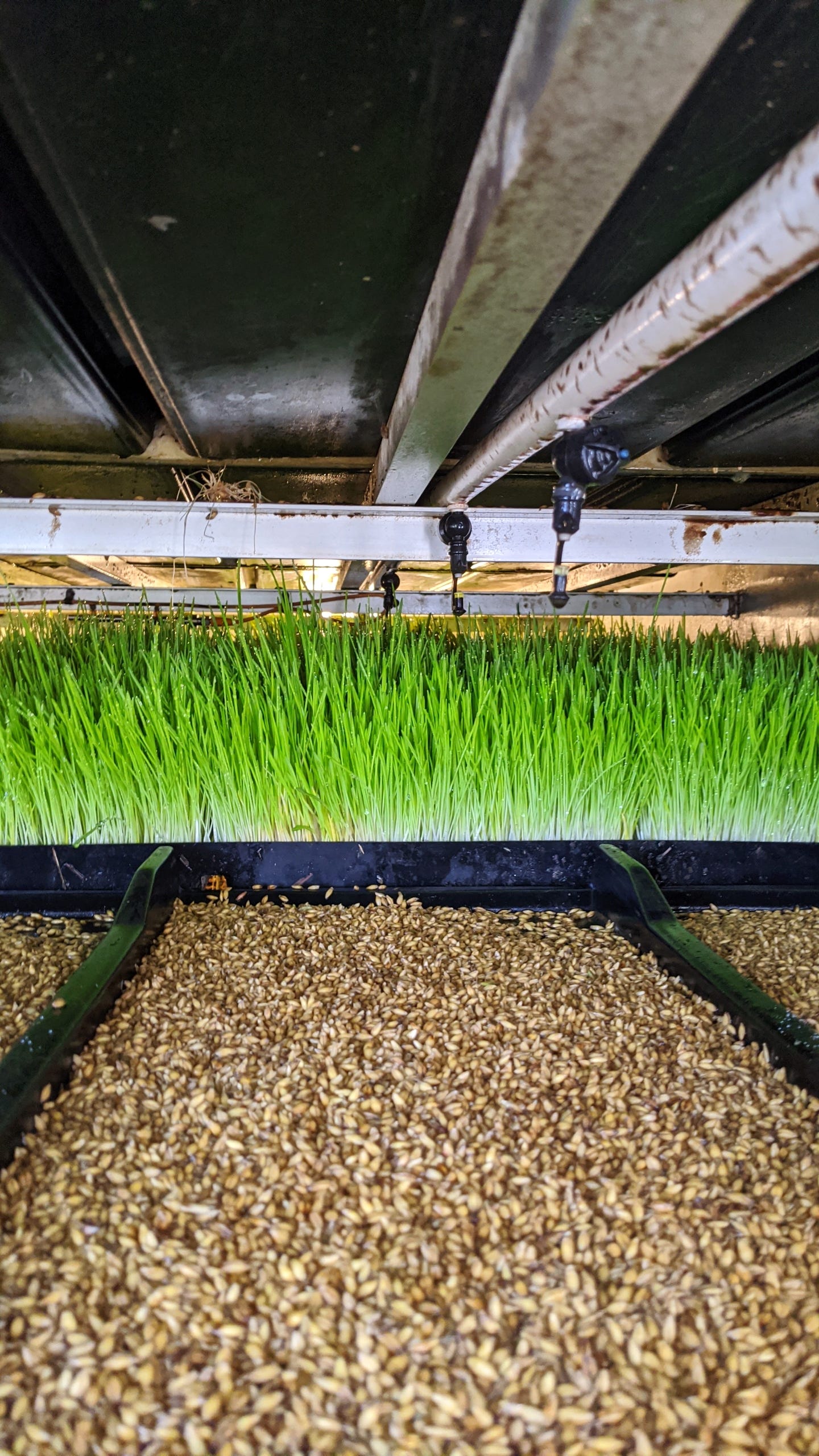
The simple solution was to repair the fodder system’s air conditioning unit and seal it back up, so it behaves more like a closed-off chamber within the Earth. As soon as we stopped soaking the grain for too long, all those pests vanished, a lesson in “excessive moon forces” on the germinating side of plants.
As with most insights, I have been forced to draw them from the school of hard knocks: things breaking on the farm, animals getting sick, my own mistakes, and so on. By paying attention to each crisis, we can learn valuable lessons. If we blame anything other than ourselves and fail to seek out the causes of what went wrong, we can experience entire lifetimes without ever learning a thing. Harvesting wisdom from the muck of experience is like sifting for gold in mud — or composting manure: alchemy never happens without our concerted effort.
In the Agriculture Course, Steiner gives an example of a dirty kitchen. A “dirty” kitchen attracts flies, he says, but he means that a filthy kitchen provides enough food for flies to lay eggs and reproduce. When Steiner describes a “dirty” kitchen, he implies a space full of available food that attracts the creatures it harbors. If flies enter a clean kitchen, they can only die if there is no sustenance for them.
It is not possible to have an ongoing fly problem without a steady supply of food for their larvae. It is easy for flies to find their way into a clean kitchen, particularly if they are sunbathing outside the house near an entryway. The initial arrival of flies does not itself mean the kitchen is really filthy. A stray fly or two will invariably find their way into a kitchen due to the aromas, but if it is a clean kitchen, they will not become a significant problem.
The real question is not whether flies are present at all, but whether they are increasing in ever-greater numbers. If you do not have any fly larvae, you don’t really have a dirty kitchen. Concerning a specific undesired weed, Steiner says much the same thing: “If you get no seed, you have not really got the weed.”1
As the rotting barley attracted pests that feed on barley plants, this principle is at the heart of all weed “peppers.” The wanton destruction of the seed of a particular species has a direct and deleterious effect on its power to reproduce and feeds specific parasitic entities. As Paracelsus writes, “The expulsion of a useless, ethereal fluid results from this act, incapable of producing offspring but instead bringing larvae into existence.”2 A fodder system is a bioreactor that produces enzyme-rich water exuding from its germinating seeds. If this enzyme juice is not constantly cleaned out of the fodder system and returned into the Earth itself, there is a constant danger of attracting pests. Steiner described plants collectively as “male” and the Earth as “female” on a spiritual level, saying that “the earth is the mother-womb of the plants.”3
If this living sap is unable to breathe, or is not buried within the Earth, it putrefies, and the fermenting scent given off by sprouting seeds is an attractant for harmful “larvae.” According to Paracelsus, the only safe place for germinating seeds is the “womb, the one environment guaranteed not to produce a homunculus.”4 As residual flour in the kitchen can provide food for undesirable critters with an appetite for grains, so too plant and animal products not properly composted can attract pests with their odors. When we make pest peppers, it is expressly our aim to compromise the seed-forming process of a specific troublesome plant.
Krishna tells Arjuna in the Bhagavad Gita, “Permeating the earth I support all beings by (My) energy; and having become the liquid moon, I nourish all herbs.”5 Too much of any good thing is problematic, too much of the “liquid moon” force, and a plant will produce nothing but leaf after leaf. Or, in Steiner’s parallel words, “Were only the etheric body to work, then the plant would unfold endlessly leaf by leaf; this is brought to a conclusion by the astral body. The etheric body is muted by the astral.”6 This is to say: an overnourished body loses the capacity to have higher cognitive functions (“chakras”) and languishes in the leafy state, appearing to thrive in a superficial sense while being shut off from its proper spiritual flowering. Excessive ethericity keeps us in a dreamlike vegetative state, unable to produce thoughts full of germinal force. The way to destroy negative tendencies (vasanas) is to roast them in the fires of meditation — the toasted seeds remain, but their germinal force is destroyed and can no longer produce more negative actions. Any well-established negative habits must be uprooted manually. Nonetheless, their seeds can be rendered not only inert by meditation but also a powerful “pepper” against one’s ongoing negative habits, restricting their proliferating power.
Pest peppers are a method of creating a pathogen vector — a substrate for pests and diseases that target one specific species by compromising their reproductive capacity. According to Paracelsus, when the seed “does not come from appropriate matter (nutritious substratum), it will not produce anything good, but will generate something useless.”7 This is the principle at work with larvae eating grain, where seeds are not entombed adequately within the earth or sealed within chambers resembling the Earth’s maternal protection. This is also the principle of making pest peppers: gathering the proliferating seeds, and making sure they cannot unite with their “nutritious substratum,” but deliberately generating “something useless” for that particular species.
Suppose anyone imagines peppering to be “unfair” or “violent” to the weed. But as Swami Chimayananda reminds us in his commentary on The Holy Geeta, “Seeds of weeds cannot but produce weeds; bad thoughts can manifest only as bad actions.”8 Were it really negative to inhibit anything at all, the same must apply to larvae and rodents: it is equally “unfair” for people to exclude pests from their granaries, kitchens, and refrigerators. Such thinking doesn’t get us very far. Rodents naturally eat whatever seeds are most pervasive, and leave behind half-rotted seed force in their manure (which they must eat again and again to extract its full value). Rodents create “peppers” with their manure, always eating most of whatever is superabundant, resulting in “peppers” that dynamically encourage more diverse ecosystems. We must remember that, in the scheme of nature, our granaries are artificial situations; therefore, we cannot blame rodents for trying to do their jobs by eating whatever seeds are most readily available.
Steiner also suggests that we might burn the root together with the seed to enhance the effect of a pepper. Where is the root nature in a mammal? The brain, but specifically the contents of the bones. In Steiner’s view, and Aristotle’s before him, the white and red corpuscles begin in the bones and culminate in the mammalian reproductive powers. To enhance a mammalian pepper, one would use not merely the seed power contained in the outermost male skin, but also the bones. As Dr. Karl Koenig says, “[W]ithin the bone-marrow, within the hardest, heaviest part of the mammalian body, the light is born—the light in the form of red and white corpuscles.”9 When we recall that Sepp Holzer’s remedy against deer in the orchard is a “bone sauce” made from charred bones, the image of the biodynamic peppers expands beyond its original confines. A pepper made merely of the seed power merely inhibits reproduction but it does not weaken the blood itself — the blood that would otherwise culminate in reproductive power — to weaken the blood requires burning the bones, even the brain matter of the same animal. This we do naturally with insects, where both the reproductive organs and the ventral nerve cord are burned with the entire insect. Not only is the blood what produces kundalini light, all spiritual paths take great pains to remove blood from meat:
“All the children of God, in every land and age, have abstained from blood, in obedience to an occult law which asserts itself in the breast of all regenerate men. The mundane Gods are not averse to blood, for by means of it they are invigorated and enabled to manifest. For the mundane Gods are the forces of the astral element in man, which element dominates in the unregenerate. Therefore, the unregenerate are under the power of the stars, and subject to illusion. Inasmuch as a man is clean from the defilement of blood, insomuch he is less liable to be beguiled by the deceptions of the astral serpent. Therefore, let all who seek the Hermetic secret, do their utmost to attain to the Hermetic life. If entire abstinence from all forms of animal food be impossible, let a lower degree be adopted, admitting the use of the least bloody meats only--milk, fish, eggs, and the flesh of birds. But in such a case, let the intention of the aspirant be continually united with that of Nature, willing with firm desire to lead, whenever possible, a yet more perfect life; so that in a future birth he may be enabled to attain to it."10
A remarkable image strikes us here: dietary regulations around meat are rendered moot — if meat is not eaten! By contrast to this “lightening” tendency in every spiritual path, a notorious food like blood sausage (black pudding) inflames the blood beyond its natural qualities rather than refining the blood or lightening it, has a tendency to make tempers run hot. Along similar lines, Dr. Karl Koenig says, “[Pork] acts a little like alcohol it wipes out the individual identity …. If you see people who eat pork, you will find that they are somewhat benumbed in regard to their ‘selfhood.’ ... the fire of alcohol and the fire of the pig are something very similar.’”11 The consumption of blood of mammals or mammals more closely related to human beings has an initial blood-inflaming quality, but then the human organism expels the excess blood and overcompensates, leading to an innervated condition of the blood which has a total weakening effect as well as a weakening of reproductive force and therefore also the dimming of one’s Kundalini light.
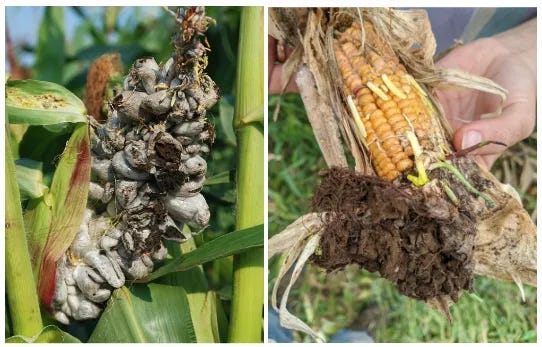
When seeds are oversaturated with water, they rot. This is true when sprouting barley and harvesting corn. On both ends of the plant: germination and the production of seeds, if there is too much of the “moon” (coarse juices), it renders both impotent. Instead of thriving, they rot. This is why Steiner says, “In a certain sense rainwater is necessary to the manure.”12 The dark juices of manure and compost must be diluted through leafy growth so that only delicate, refined nectar reaches the seeds. If the sap that enters the ovaries is too fertile, the seeds grow fungus.
Goethe describes the entire essence of fertilizing in the Metamorphosis of Plants: “It has been found that frequent nourishment hampers the flowering of a plant, whereas scant nourishment accelerates it.”13 Particularly towards setting seeds, the plant must receive clean water to the summit of the plant, without which it cannot reproduce. Rabbi Nahman of Bratzlav, incidentally, suggests much the same thing when he says, “Rainwater is a cure for impotence.”14 Rainwater arrives, diluting the coarse, heavier juices of manure, allowing the seed to reach its full potential.
Much the same applies to our inner spiritual lives: if we are “oversaturated” with lower sensory stimulation, the best our souls can arrive at are distorted thoughts polluted by the “coarse juices” of the sensory world: a thought that feels pleasant will be taken to be true, and an unpleasant thought will be dismissed as false without any self-reflection. To arrive at clear, viable thoughts, and not just bloated fungoid ideations, we must be deprived of excessive nourishment. There is a significant danger in affluent countries of overfeeding the body, which easily hinders the development of higher cognitive functions.
Thinking, like meditation, is uncomfortable because it requires withdrawing the center of our attention from our peripheral nervous system and from the immediate effects of the external world on our body. We cannot develop a “personal relationship with manure” unless we learn to sit with the stink of manure without antipathy towards it. There is nothing sensually “rewarding” in the hard work of such thinking, particularly not in any immediate sensual way.
To those habituated to sensory stimulation, the inner spiritual world initially feels like a dark, empty desert at night. It takes time for one’s eyes to adjust to the apparent darkness of contemplation, but then planets begin to appear, and next the celestial stars make their presence known, and then the glow of the Milky Way shines through. The “light pollution” of the outer sensory world, with its kaleidoscopic display of treats, feels like a lush tropical jungle by comparison. Unfortunately, we often assume that brightly colored experiences must necessarily be good. This is hardly true out in wild nature, so why would it be true in the soul?
Some of the very best thoughts criticize oneself with a still small voice of conscience, which often cannot be heard in the din of daily life. Thinking often feels bad because it shines the light on our own real shortcomings. These days, people frequently imagine it’s bad to feel bad — as if it’s a “negative” thing to feel any moral obligation to the world or a debt of courtesy towards other people. Recognizing that we are taking whenever we farm while maintaining active gratitude, and giving back more than we take is motivated by the pangs of conscience, not by hunger. Even our generosity is only born out of what we could never have earned: the possibility of life itself. We must first exist to do anything meritorious; therefore, we can never merit existence itself through any effort of our own. We remain obligated to be perpetually gracious thanks to the gratuitous nature of the universe.
We choose one form of life over another whenever we prevent pests from harming our crops, such as using clay pots to protect food from mice or refrigerating food to prevent mold growth. Our approach should never be vindictive and should align with what we genuinely need. There is nothing wrong with this because all living things must nourish themselves. But when we remove something from its natural cycle, we have to contrive all sorts of ways of preventing it from quickly going back to Nature. Whenever we store food or even make compost, we are placing our hand on the “wheel of life” and requesting that some energy linger in one place quite a bit longer than it naturally would.
Sir Albert Howard reminds us:
“The wheel of life is made up of two processes — growth and decay. The one is the counterpart of the other…. There is no break in the chain from soil to man; this section of the wheel of life is uninterrupted throughout; it is also an integration; each step depends on the last. It must therefore be studied as a working whole.”15
There is a significant moral weight to interfering with the wheel of life. If we are going to take from the cycle of life, we should only do so in a way that encourages ever more life. This moral sensitivity is ancient, and one in which people knew to feel bad for storing up food. The presbyter Tyro reports this prayer from followers of Manes:
“Not I have harvested thee,
nor have I finely ground thee,
nor do I place thee in the oven.
Another accomplished this deed. . . .
Guiltless I ate it.”16
Ehrenfried Pfeiffer writes, “Man felt guilty about taking the harvest away from Demeter, the goddess of Nature, and used all sorts of images to express his grief.”17 Festivals were not originally feasts of celebration, but times of cautious penitence. There is nothing wrong with being grateful at festivals, but we cannot truly be thankful if we do not always recognize that every gift is also a debt we owe back to the world. With each gift we receive, we owe the “return-gift” of gratitude to the source of the gift, and, since we can never really repay the gift, we also owe graciousness to others.
Unlike plants, which are beholden to the weather outside, we have an entire inner universe. Unlike animals or plants, we as human beings can choose our inner climate by selecting what we give our attention to. How do we regulate our inner atmosphere? How do we place ourselves in the light of the spiritual sun? How do we restrict polluting sensory stimuli and avoid overnourishment? How do we allow the soul to blossom? How do you practice brightening your own soul?
Do you seek the highest, the greatest?
The plant can be your teacher:
what it is without volition
you can be willfully—that’s it!Friedrich Schiller
R. Steiner, Agriculture Course, Lecture VIII (GA327, 16 June, 1924, Koberwitz)
Paracelsus, De Origine Morborum Invisibilium
William R. Newman, Promethean Ambitions, pg. 222.
R. Steiner, Goethe’s World View, GA6
The Holy Geeta, Chapter XV, verse 13
R. Steiner, Stuttgart, February 8, 1909, GA98
Paracelsus, De Origine Morborum Invisibilium
The Holy Geeta, pg. 1024
Karl Koenig, Earth and Man, pg 26.
Editors note in Hermetica (Ouroboros Press) page 260.
Karl Koenig, Earth and Man
Sir Albert Howard, An Agricultural Testament, pg. 23.
E. Pfeiffer, The Earth’s Face, pg. 107
As quoted by Pfeiffer in The Earth’s Face, pg. 107.
R. Steiner, Agriculture Course, Lecture V (GA327, 13 June 1924, Koberwitz)
Goethe, Metamorphosis of Plants, P30
Rabbi Nahman of Bratzlav, Sefer ha-Middot, segullah 3